
Mikhail Kuzmitskii
Founder of seo·matrix
In SEO since 2009 — from junior specialist to Head of SEO; now building autonomous AI content systems.
About
I built my first website back in 2007 and moved into SEO in 2009. With a background in Physics and Computer Science, I always take a scientific, data-driven approach: hypothesis → experiment → data analysis → conclusions → solution.
Credentials & achievements
Diploma
Maxim Tank Belarusian State Pedagogical University (BSPU)
Higher education, Specialist's degree · Physics & Computer Science

Posts by this author
SEO trends, autumn 2026: what the world's leading analysts are actually saying
68% of Google searches now end without a click, Google says optimizing for AI 'is still SEO', and the people who measure this for a living disagree on almost everything else. Rand Fishkin, Lily Ray, Kevin Indig, Aleyda Solís, Mike King, Cyrus Shepard and Glenn Gabe — quoted verbatim, with sources and dates.
Read →
Embeddings for SEO: six ways cosine lies on a live corpus
Embeddings find the near-duplicates and link candidates string matching can't see — and then quietly mislead you six specific ways. Field notes from running them over live corpora: boilerplate at cosine 1.0, thresholds, length bias, stale vectors, invisible cost.
Read →
Answer Engine Optimization (AEO): the complete guide for 2026
Answer Engine Optimization is optimizing content to be the answer an engine returns, not a link in a list. What AEO is, how it differs from SEO and GEO, the six things engines actually reward, and how to measure it.
Read →
AI SEO tools in 2026: what the categories actually do
AI SEO tools split into four categories that solve different problems: AI-visibility trackers, AI-readiness auditors, AI content generators, and classic SEO suites with AI features. What each does, when you need it, and how to avoid paying twice.
Read →
FAQPage and structured Q&A for AEO
Google retired FAQ rich results for most sites, but answer-first Q&A plus FAQPage JSON-LD is still the highest-yield AEO pattern. How to do it right, and where it becomes spam.
Read →
Bing AI Performance: the first first-party report on AI citations
Microsoft's AI Performance report shows how often Copilot cites your pages — real first-party data, not estimates. What it measures, what it can't, and how to track it over time.
Read →
Programmatic SEO (pSEO) done right in 2026
Programmatic SEO scales templated pages by the thousand. How to add real per-page value, survive scaled-content policies, and make each page an AI-extractable answer.
Read →
AI crawler log analysis: what GPTBot and ClaudeBot actually fetch
Read server logs for GPTBot, ClaudeBot and PerplexityBot: find coverage gaps, wasted crawl and blocked assets, and prove AI bots reach your content.
Read →
Content decay in the AI-search era: when and what to refresh
Content decay is the slow slide of rankings, traffic and citations as facts age. The signals to watch, the refresh trigger, and refresh vs rewrite vs consolidate.
Read →
The citation-worthiness playbook: how to get quoted in AI answers
AI answers quote some sources and skip the rest. The traits models prefer: original data, crisp definitions, answer-first passages, first-hand insight.
Read →
Schema markup AI Overviews actually use
Which Schema.org types AI engines read in 2026 and which they ignore - FAQPage, HowTo, Article, Product, Organization+sameAs - plus JSON-LD placement and fixes.
Read →
Topical authority and internal-linking silos
Hub-and-spoke silos build topical authority for rankers and AI models alike. How to cluster, link, and beat cannibalization without leaking equity.
Read →
AI visibility metrics: how to measure GEO in 2026
Rank tracking can't see AI answers. The five GEO metrics that can — AI Share of Voice, citation rate, answer-inclusion rate, prompt coverage, referral traffic.
Read →
Multilingual GEO and hreflang for AI answers
hreflang tells engines which language version to serve. How it shapes AI answer engines, cross-language cannibalization, and per-locale entities.
Read →
llms-full.txt: the whole-site context file AI answer engines read
llms.txt is the index; llms-full.txt is your entire site as one clean-text file. Why one big file beats a crawl, what goes in it, and how to ship it.
Read →
Entity SEO: build your entity in the Knowledge Graph
AI answers resolve entities, not keywords. How to become an answerable node in the Knowledge Graph with consistent naming, sameAs links, and stable facts.
Read →
You 'protected' yourself from AI bots — and silently vanished from ChatGPT Search
AI crawlers play 4 different roles, and blocking each has its own price. The 2026 registry of 19 bots, the #1 robots.txt anti-pattern, and the correct configuration.
Read →
Free rank checker: where you REALLY rank in Google and Bing — and what sits above you
Personalization distorts your own SERP. The free rank checker shows your domain's true position in a clean Google or Bing top-100, plus who holds the top-10 and whether an AI Overview sits above you.
Read →
E-E-A-T signals AI engines actually read
AI answer engines can't feel your expertise - they verify it. The E-E-A-T signals that are load-bearing in 2026, and the decorative ones that aren't.
Read →
Does your robots.txt let AI in? We ran 6 famous sites through the free checker
Before optimizing content for AI answers, answer question #0: can AI crawlers read your site at all. A breakdown of the free access checker (27 bots, 3 roles) and the real robots.txt of Reddit, NYT, The Verge and Medium.
Read →
Who Google cites in the AI Overview — and whether you even have one
Not every query triggers an AI Overview, and when it does Google often cites Reddit and YouTube over brands. A tour of the free AI Overview checker on live examples.
Read →
Google now runs two different searches — and you optimize for one
AI Overview and AI Mode run on different engines: AIO leans on the classic results, AIM is vector semantic search. The data (600+ parameters) and the two distinct strategies.
Read →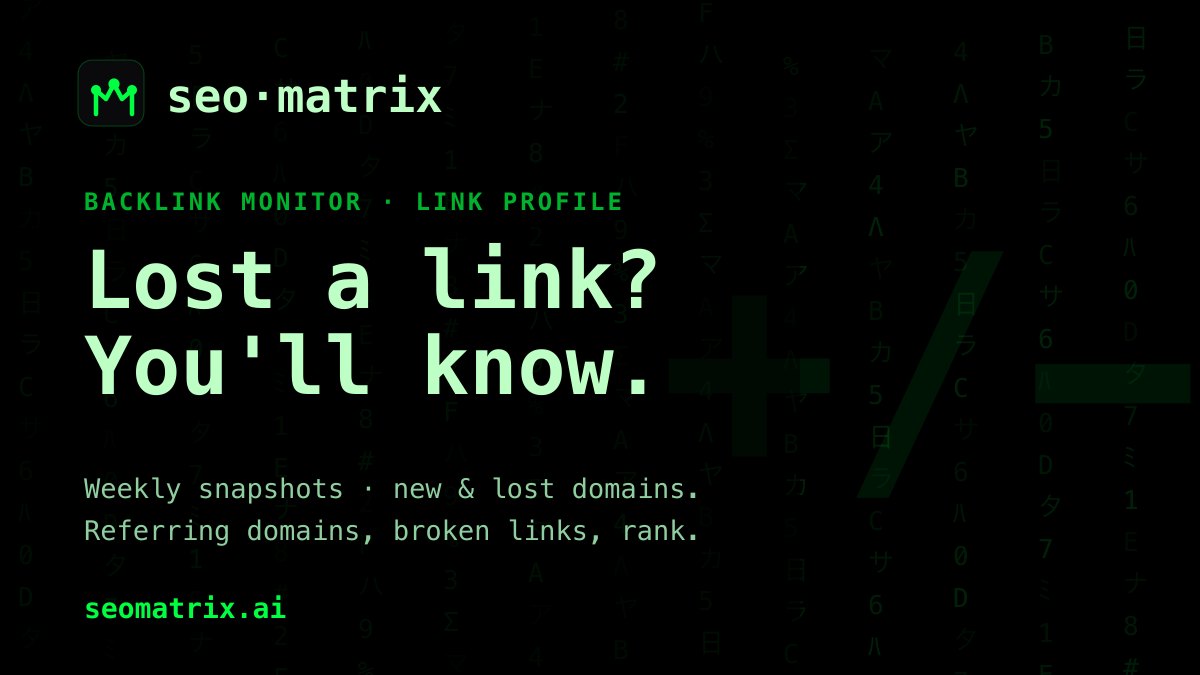
Backlink monitoring inside Pro: why pay $129 for a suite when you only need link control
Most sites need one thing from a backlink tool: to know when links appear and disappear. How Backlink Monitor inside the Pro subscription ($59/mo) works — weekly snapshots, a new/lost diff and Telegram alerts — versus a $129+ Ahrefs subscription.
Read →
Site Audit Monitor: a weekly auto-audit that catches regressions before traffic drops
A one-off audit goes stale at the next deploy. Site Audit Monitor re-audits your pages weekly (GEO/SEO scores), computes the delta vs the previous run and alerts you on a drop — included in the Pro subscription ($59/mo) versus Sitebulb Cloud from £95.
Read →
AI brand monitoring: Share of Voice and brand visibility in AI answers
AI brand monitoring tracks how often AI answers mention your brand and in what light. AI Share of Voice, AISVS and brand sentiment: what they're made of, how citation rate differs from persistence, and how to measure it.
Read →
Answer capsules: why AI cites some sections and skips others — a free checker
AI answer engines lift a self-contained 40–75-word paragraph placed right after a heading — the "answer capsule". How the free capsule checker works, and an honest run on our own articles (spoiler: 44%).
Read →
Local Grid: geo-grid rank tracking — why you need it and how ours differs from Local Falcon
Your Google Maps position depends on WHERE the customer searches from. A geo-grid scans the local pack from N×N points around your business and maps your visibility + SoLV. A review of our Local Grid vs Local Falcon and BrightLocal.
Read →
Make your robots.txt a landmark: ASCII art that crawlers and developers will see
robots.txt is read by curious developers, not just bots. Our generator now adds ASCII headers in five styles — from Matrix to a note-to-AI-crawlers. Plus why it doesn't hurt SEO.
Read →
Is your site ready for AI agents? A free 10-second agent-readiness check
AI agents already browse sites instead of humans. We break down the 6 machine-readability signals — llms.txt, structured data, author markup, sameAs, markdown alternates — and how to push your agent-readiness score to 100.
Read →
Where ChatGPT, Perplexity, Claude and Gemini get their answers
ChatGPT favors Wikipedia, Perplexity favors Reddit. Tables are cited 2.5×, fresh content 3.2×. Here's where engines pull citations from and how to make a page 'extractable'.
Read →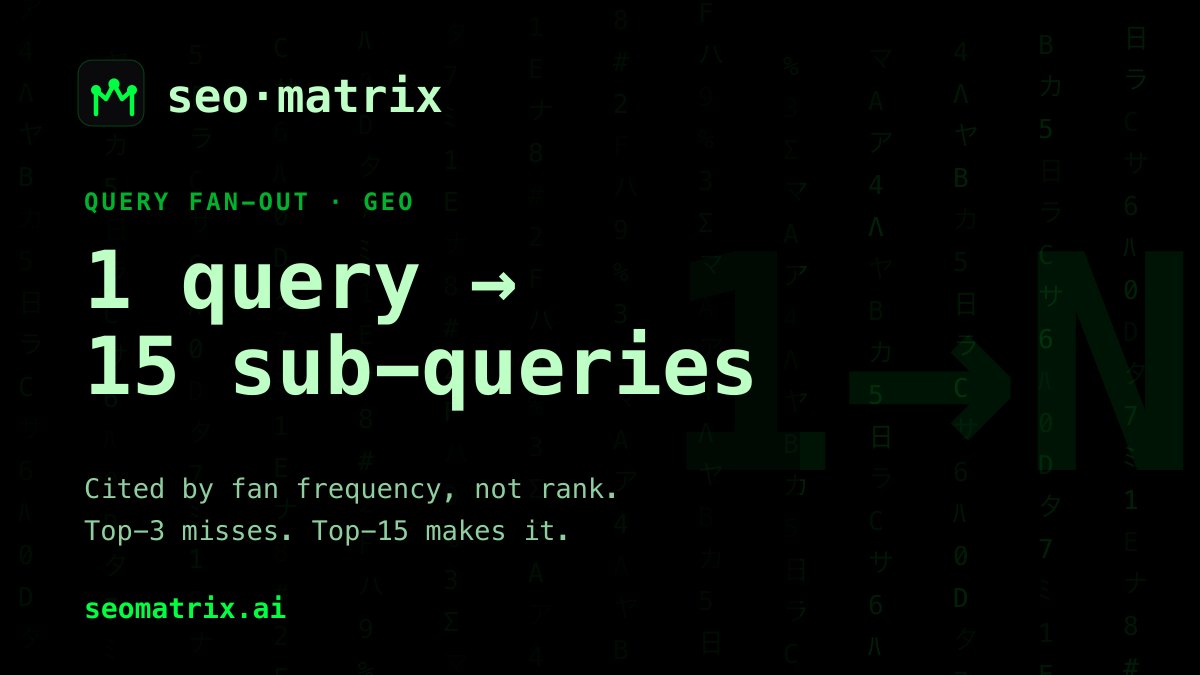
Google no longer searches your query — it searches 15 others
Query fan-out: the engine splits one query into 5–15 sub-queries and cites by how often you land across the fan, not by rank. Why top-3 misses and top-15 gets in — and what to do.
Read →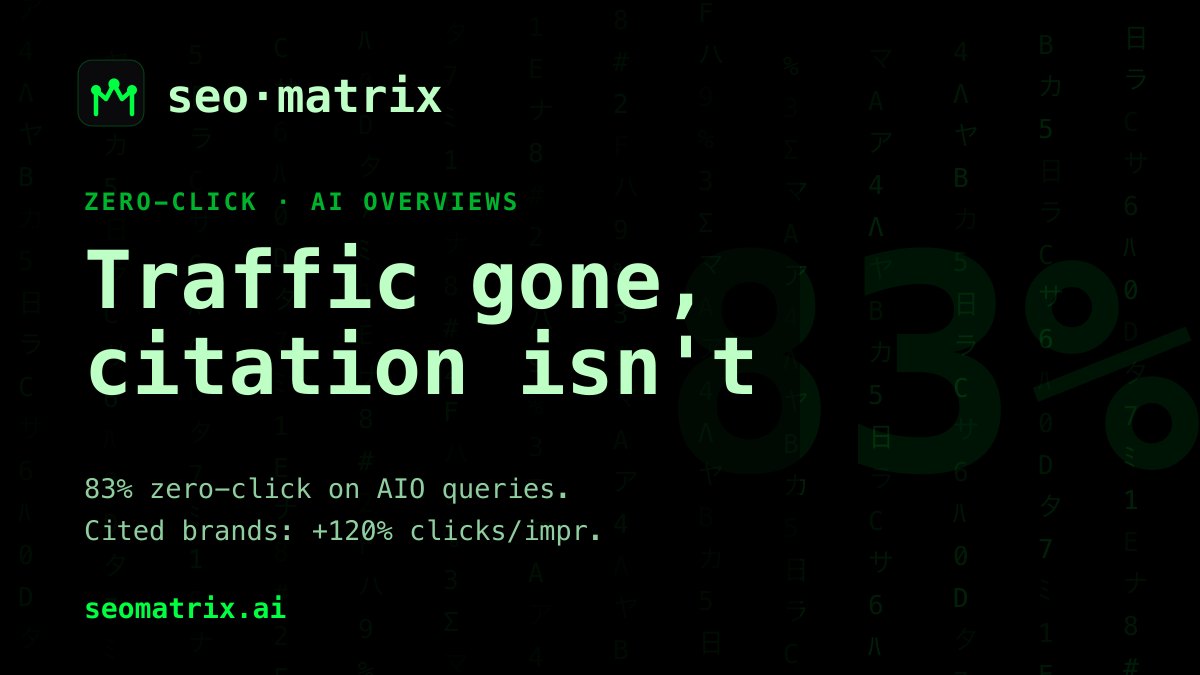
The traffic is gone, the citation isn't: zero-click data 2026
Zero-click hit 83% on AI-Overview queries. Yet cited brands earn 120% more clicks per impression. Here are the numbers and what to do with them.
Read →
Buy it in ChatGPT: how not to be invisible to AI shopping agents
On Feb 16, 2026 OpenAI opened checkout inside ChatGPT. A product without a machine-readable feed and Schema.org simply never enters the agent's comparison set. Here's what to check now.
Read →
Self-driving SEO: how a site fixes itself — and where the stop-cock is
Launch is half the job. Auto-pilot watches positions, finds dips and stale content, and applies safe fixes — under budget, cooldown and caps. Anything…
Read →
Google doesn't read your text — it extracts triples
Machines store triples (subject–predicate–object) in the knowledge graph, not paragraphs. If a fact can't be parsed into a triple, AI won't cite it. How to write for extraction.
Read →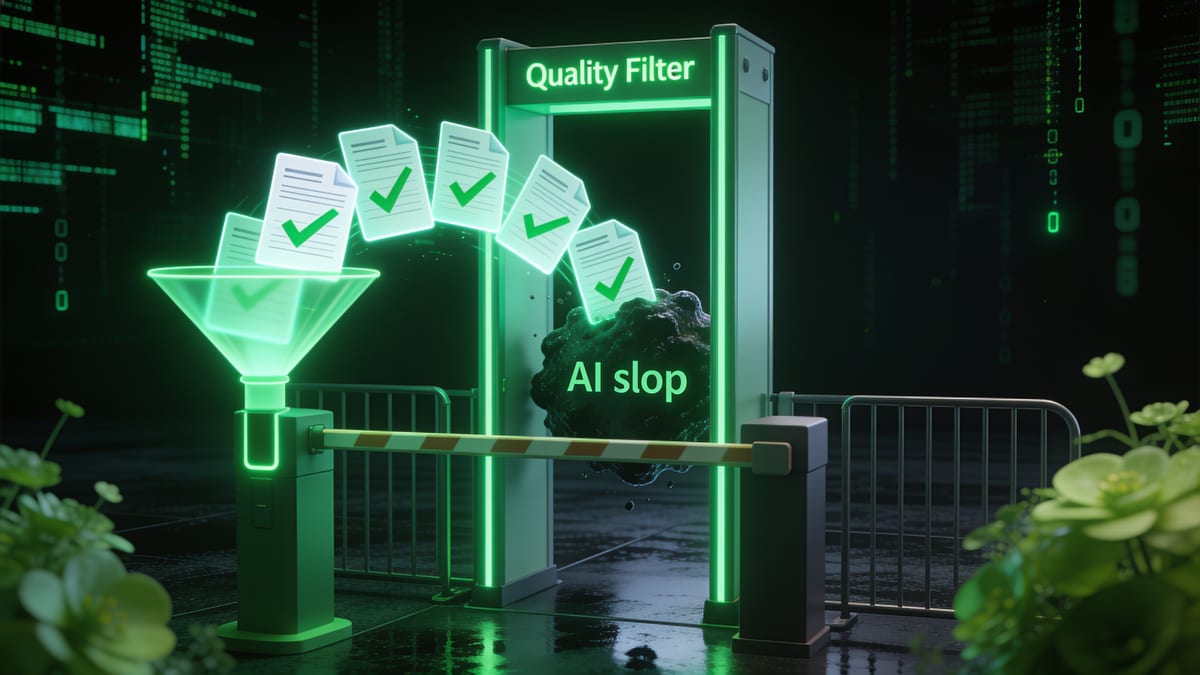
Our editor rejects AI slop — before it's published
AI generates at scale, and Google penalizes 'scaled content abuse.' So our pipeline refuses to publish slop to itself: information-gain, anti-AI-isms…
Read →
301, 302, 307, 308 — the difference and when to use each redirect
HTTP redirects made clear: 301 vs 302 vs 307 vs 308, permanent vs temporary, request-method preservation, and the impact on SEO and AI crawlers. With tables, use cases and common mistakes.
Read →
canonical vs redirect — which to choose and when
rel=canonical and a 301 solve different problems: one keeps the URL, the other removes it. When to use canonical, when to redirect, common mistakes, and the impact on indexing.
Read →
Why AI can't see your React/Next site — and the fix
An SPA serves AI bots an empty HTML shell: GPTBot and PerplexityBot don't run JS. How to check what the bot sees and make your content AI-visible.
Read →
How to make a WordPress site visible to AI answers (2026)
Step by step: schema, llms.txt, AI-bot access, citable paragraphs and E-E-A-T — get your WordPress site into ChatGPT, Perplexity and AI Overview.
Read →
The cannibalization Ahrefs can't see
Lexical tools compare words. But two pages compete by MEANING — even with no shared words. How we catch semantic cannibalization with embeddings: dup-scan…
Read →
The free GEO toolkit: 50 tools + 28 niche playbooks
We shipped a free, no-signup GEO toolkit: 50 tools to diagnose and fix whether AI engines cite your pages, plus 28 industry playbooks.
Read →
AI search optimization: the complete GEO guide (2026)
Generative Engine Optimization — also called AI search optimization or LLM SEO — is how you get cited by AI. How GEO differs from SEO, how AI engines pick sources, and a step-by-step playbook for ChatGPT, Perplexity and AI Overview.
Read →
AI visibility tools: who ChatGPT and Perplexity cite for your queries
An AI visibility tool asks the engines directly instead of reading Google's results. What an AI-citation tracker measures, how it differs from a rank tracker, and how the free pre-check keeps the paid probes on winnable queries.
Read →
What is GEO and AI Overview — and how to get cited by AI
GEO (Generative Engine Optimization) is optimizing pages so AI answers — ChatGPT, Perplexity, Google AI Overview — cite you as a source. The short definition, how it differs from SEO, and how engines choose what to quote.
Read →
llms.txt — why your site needs one and how to build it
llms.txt is a site map for AI engines: a curated list of your important pages in Markdown. How it differs from sitemap.xml, and how to add llms.txt and…
Read →
SEO vs GEO in 2026: how they differ and why you need both
SEO fights for a link position, GEO for a citation in the AI answer. The differences, where they overlap, and why in 2026 you run both fronts at once.
Read →
An autonomous AI SEO team: from brief to a live site
How a team of 20 AI agents runs the pipeline from brief to a published site — strategy, content, GEO, internal linking — under a transparent budget and…
Read →